Viser søkeresultater 1 til 7 av 7
Tråd: Jod i døgnurin
Threaded View


-
11-01-14, 15:44 #2

 Co-admin
- Medlem siden
- Mar 2009
- Sted
- Sverige
- Alder
- 81
- Meldinger
- 2,323
 Sv: Jod i døgnurin
 Opprinnelig skrevet av Mod

Iodine Deficiency in Europe: A continuing public health problem
Kilde WHO: http://www.who.int/nutrition/publica..._in_Europe.pdf
2.3.2 Urinary iodine
Urinary iodine (UI) is a good marker of the recent dietary intake of iodine. It provides an adequate assessment of a population’s iodine nutrition and is now the index of choice for evaluating the degree of iodine deficiency, and for monitoring and evaluating its correction (27). Because 24-hour samples are difficult to obtain it is emphasized that this is not necessary and that iodine concentrations can be measured in casual urine specimens of children or adults provided a sufficient number of specimens (usually at least 30 schoolchildren per cluster) is collected (27). It is reported as micrograms/litre (µg/l) of urine. Relating UI to creatinine is expensive and unnecessary (27).
As the frequency distribution of UI is usually skewed towards elevated values, the median is considered more useful than the mean to indicate the status of iodine nutrition in a population.
Table 2.5 shows the epidemiological criteria presently recommended for assessing iodine nutrition based on median UI concentrations in school-age children (27).
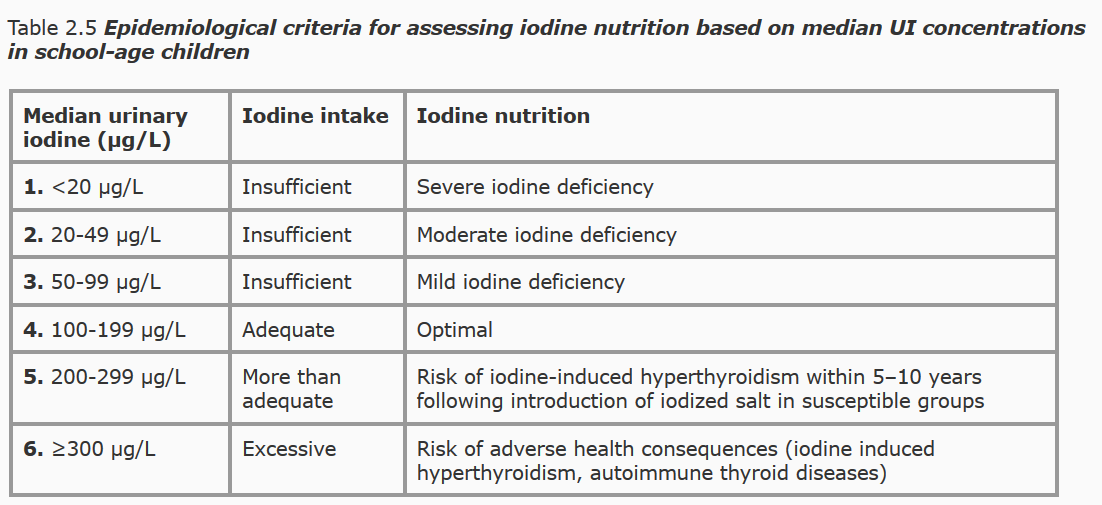
For større bilde av tabellen - klikk her.
Source: (27) WHO/UNICEF/ICCIDD Assessment of iodine deficiency disorders and monitoring their elimination: A guide for programme managers. Geneva, World Health Organization, 2001 (WHO/NHD/01.1)
In pregnant women a median UI <150 µg/L indicates insufficient iodine intake, 150–249 µg/L indicates adequate intake, 250–499 µg/L reflects more than adequate intake and ≥ 500 µg/L indicates intake for which no added health benefit is expected.
Source: (29) Technical consultation for the prevention and control of iodine deficiency in pregnant and lactating women and in children less than two years old. Geneva, World Health Organization, 2007. (To be published)
Kilde WHO: http://www.who.int/nutrition/publica..._in_Europe.pdfTil alle norske og danske stoffskifte-pasienter, anbefaler vi boken STOP stofskiftevanviddet, skrevet av verdens ledende pasient-aktivist Janie Bowthorpe, som i 2005 grunnla nettstedet Stop The Thyroid Madness. Boken er utgitt på dansk i 2014. För alla svenska hypotyreos-patienter, rekommenderar vi samma bok, översatt till svenska med titeln Stoppa sköldkörtelskandalen (2012). Til alle gode leger, og pasienter som ønsker å lære mer av "the right stuff", anbefaler vi boken Stop The Thyroid Madness II (2014) med bidrag fra 10 leger MD. I Skandinavia, definitivt de to beste og mest nyttige bøker for hypotyreose-pasienter, for deres familier og venner, og for deres leger.

 Svar med sitat
Lignende tråder
-
Cortisol døgnurin
Av Nitelite i forumet Cortisol / ACTHSvar: 40Siste melding: 09-04-11, 15:30


Bokmerker